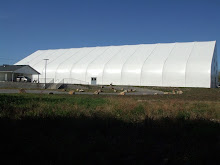
Last weekend the Show Me Agility Club of Central MO had our AKC agility trial at CCSC. This was the fourth AKC agility trial that I've served as Trial Chair, which is another way to say "chief finger-pointer, worrier, obsessor, and over-organizer." But an AKC agility trial is a huge club-wide effort and I thought I'd give some insight on how much work goes into the final product of two (hopefully flawlessly run) days of agility.
Agility trials are often planned well over a year in advance. I line up a judge and secure the venue. This was our first time at CCSC. Previously we'd been at the Boone County Fairgrounds. There were a number of differences between the sites we needed to deal with. The Fairgrounds is on a dirt arena, where we can hammer down the obstacles that move easily like tunnels and weaves. Can't hammer into the rubber flooring at CCSC, so we needed to adapt. In this case, that meant that the equipment chair (Kathy) and I collaborated on ordering new sets of weave poles that would work better on the rubber surface. We also had a club work day and made sure all of our tunnel weights (sandbags) were nice and heavy. CCSC would also mean a different ring layout and different duties. We had to establish a grounds chairman (Gary R) to do things like monitor trash and help people park efficiently. As part of our contract, we had to clean the arena before and after the show, which meant a massive vacuuming effort. We vacuumed the entire building on Friday. That's 28,800 square feet of vacuuming. Some of our competitors, coming in early from all over the midwest, actually helped us. Agility people are great. We also needed to get a food vendor in (Jamaican Jerk Hut) as well as snacks for our large corps of volunteers who work the show in exchange for being fed. Patti organized that.
Our club hires a trial secretary because we don't have time to do that ourselves. She gets the Premium (the info people use to enter) done and also actually accepts and processes all the entries people send. She prints up armband numbers and running orders, sends out notices to people that they've been entered, and deals with early withdrawals. She prints up a sheet for each dog to be used on each day of the show so their score and time can be individually recorded. On the day of the trial she processes all of the results, entering the information from each dog's run (time and faults) into her computer. She generates a result sheet and labels which our awards person (Linda in this case) takes and puts on the ribbons for placements of first through fourth and also people who qualified but didn't place in the top four.
Our judge (Bonnie D from the Chicago area) stands in the arena all day both days and makes calls. She's designed the courses for each level (Novice, Open, Excellent) and each type of run (Standard, Jumpers with Weaves). She is the ultimate authority on the show site on things that go on inside the ring. I am the authority over all things that go on outside the ring.
When the trial rings are actually running it's a symphony of motion. Each dog and handler team comes out into the ring and to the start line just as the previous team is finishing. The timer, who runs our electronic-eye system, presses the "Go" button and the team starts. The judge watches the dog and handler and has a series of hand signals to indicate any faults she sees such as refusing an obstacle or jump, going over the wrong jump/obstacle, not putting a paw in the safety zone at the bottom of each obstacle, and/or dropping a bar. The scribe at the side of the ring is intently watching the judge for those hand signals and writes each error down (if any) on the scribe sheet for that dog. When the dog crosses the finish line the scribe flips her sheet over to the assistant, who writes down the time it took the dog to run and then hands it to a runner. Meanwhile the scribe is already doing the next dog, and the runner takes the sheet to the secretary to enter into the computer.
The organization of getting that ring running smoothly belongs to the ever important gate steward. The Gate has a listing of who is supposed to be running when, and exhibitors make sure they're in line so they're ready to step forward to the start. A good Gate steward can make a trial, a bad one can break it. Oh, and I can't forget the bar setters. Each ring has at least 3 people sitting inside the ring to put bars back on jumps in case a dog takes one down. So just for the ring, you have a gate steward, 3 ring crew, scribe, assistant scribe, timer, sheet runner and a leash runner to take each dog's leash from the startline to the finish (dogs must enter and exit the ring on leash).
But that's not all. After a class is finished, Kathy, our extremely capable chief course builder, steps into the ring to build the course for the next class. She also has a crew of people who help her. Kathy's job is to make sure each class is built to the judge's specifications, and those measurements are given to her on a map that tells her exactly where each jump or obstacle goes literally to the inch. So you see her in the ring with a measuring wheel and a 100' tape.
This year we had a few hiccups that were things out of our control, so it was even more nerve wracking than usual. However, on the weekend itself, everything went perfectly. The exhibitors were thrilled with the new location, not upset by having a delay in getting their ribbons and placements on Saturday, and very complimentary. In fact I think it's our first show where no one complained about a single thing all weekend. And agility people are really the best. We had a lot of volunteers who were non-club members. Best of all, we had fun. It was a weekend of teasing and laughter, of great runs and not-so-great ones and some that were a comedy of errors. But that's what agility is all about.
For our November trial, I'll turn the Trial Chair responsibilities over to Deb H. But I'll be back next April or May for our next spring trial. It's a huge amount of work for the whole club but somehow still fun.
Wednesday, July 2, 2008
The Care and Feeding of an Agility Trial


Thursday, June 26, 2008
The new weaves have arrived.
 Viva weaving in her younger days.
Why do we need to practice on these weaves, you ask? Because the spacing on these weaves is quite a bit wider than it is on the other sets we own. See, here's the story (and you know I always have a story!) When agility started, people really just sort of threw things together as obstacles. Weave poles were replicating pole bending in horse sports and the originators thought, "well, they need to be spaced tight enough that dogs have to work a bit to get through them." Weave pole spacing (the area between each pole) is now pretty widely variable, anywhere from 18" to 24". Our previous poles were 21".
But the agility world also started noticing something. We had a huge increase in shoulder tendon and ligament injuries in larger dogs. Bicepital tendonitis is almost an epidemic in bigger dogs who have been competing for any length of time. We're also seeing a fair amount of spinal spondylosis. And some of us think these long-term chronic injuries are happening when bigger dogs weave. Especially fast bigger dogs.
When a fast big dog weaves, he single-steps. What that means is, he places one single foot out to the side and shoves against that foot to push through one weave pole. He then does the same thing with the other foot to do the next weave. It's sort of a swimming motion. And it forces the dog's front to do something it's not supposed to do--push the foreleg straight out horizontally from the body. Big dogs also have to really torque their spines going through weaves.
So when we knew we had to have new weaves for this trial, I consulted with several agility lists and an AKC rep, and we decided to go for 24" spacing, in part because it looks like AKC may mandate that spacing in their next set of rule changes (it's been a rule in Europe for years), and in part because I think it's the right thing to do. Short term, we may have a few dogs this weekend who have to adapt their rhythm. Long term, it's better and safer for all the dogs. And when it comes down to it, dogs who know how to weave are going to weave, regardless of spacing.
So a-weaving we will go!
Friday, February 1, 2008
IABCA show
For those of you in town this weekend, there's an IABCA show at CCSC. The International All Breed Canine Association holds shows where dogs are judged according to the standard of the country of origin. Written critiques are given to each dog.
I won't be there. Vicki and I are heading to Lake St. Louis to the Equestrian Center where we'll play agility. Zipper is entered in Novice. He's really not at a stage yet where I expect him to qualify. Our trip is what I call an "expensive fun match." I want to see where he is in training and get him out in a new place. My goal for the weekend is to try to keep his attention around the course and not have him go gadding off to explore something. I'll be thrilled to pieces if he jumps the broad jump, and even more excited if he does the weaves. I'll probably only try to do weaves once, maximum twice. I see so many people shut their Novice dogs down by trying weaves over and over. Not worth it!
The whole next month is sort of crazy. This weekend is IABCA here, AKC agility in St. Louis. Next weekend is the Show Me Canines UKC Agility and Obedience trial at CCSC. The following Monday/Tuesday some of our Columbia friends will be at Westminster in New York--watch for them on the USA Channel. Then some people head to Kansas City for four days of agility (not me). Then there's a week off, then John Sherman comes to CCSC to teach us about canine sports rehabilitation. The very next week is the Columbia Kennel Club show at the Fairgrounds.
My head, it spins!
Thursday, January 31, 2008
What's the best leash?
We get this question a lot. People want to know what kind of leash they should get, and how long a leash they should have.
Part of this answer is fairly simple, part is more complicated. The simple part is the kind of leash you should get to work in Obedience and/or Rally. The answer is leather. Whether it's flat, braided, wide or narrow, leather is your best answer. A quality leather leash will last you forever and only get more supple with time. I had a leather leash that I bought in 1981 and used until 2001, when it disappeared during an agility training class. It's probably still being used somewhere (and I still miss it!).
Those cute lupine nylon leashes with patterns and stitching can work for small dogs that don't pull much, but they tend to burn your hands and wear/tear over time. And chain leashes? No. Absolutely not. Too heavy, too easy to hurt yourself or the dog. Flexi/retractible leashes are also a big no-no when training. It's just impossible to properly manipulate the lead when you have that big plastic handle, and if a cord gets wrapped around your finger you're likely to be minus a digit. Neither flexis nor chain leads are allowed at CCSC. We do allow nylon leads, but far prefer leather.
Slip leads (with the leash and collar attached) are acceptable for agility but not for obedience.
If you have a larger/strong dog, you probably want a nice wide, flat leather lead with braided or riveted ends and a good sturdy snap. You can also go with a braided lead, which may give you more places to grip. Be sure to get a leash that's smoothly finished on all sides. Leashes that are "raw" leather on one side will chafe your hands. For smaller dogs and dogs who don't pull, you can go with narrower widths.
As for length, that totally depends. It used to be that a six-foot leash was required in AKC Obedience. That is no longer true. A six-foot leash is required for the Honor portion of AKC Rally Excellent, but is not required for Rally Novice. For your classes at CCSC, you'll need a leash of sufficient length to drape down and form a gentle "J" shape with the clip hanging straight down from the dog's collar when the dog is sitting by your left side in heel position. Unless you are a tall person with a tiny dog, this means a six-foot leash is overkill. In many cases, a 4-footer will work perfectly. For the smaller dogs a 5-foot leash may be better, but you need to judge that for yourself, or have an instructor help you.
And I have to end this post by putting in a plug for Rick Gallione of Master's Pride, who I think is the finest leatherworker in the U.S. I get all of my leashes and collars from him. For the quality you get they are quite reasonably priced and he will work with you extensively by phone to make sure he's making what you want. Here's Zipper wearing his custom-made Master's Pride collar. What you can't see is the back side, which has decorative hand stitching.
Happy leash hunting!
Sunday, January 20, 2008
Teaching the Teacher
 Cala (left) and Viva the day Viva retired from Rally Obedience after completing her Rally Advanced Title with a first place. Cala got her first Rally Advanced leg with a first place.
At CCSC we offer a pretty wide variety of classes. And as I've mentioned before, our instructors vary a bit in approach and training philosophy. All the instructors have a lot of experience actually competing in the sports they teach, and all instructors share a commitment to positive training. But we do differ in how we train certain skills.
Another thing you'll notice if you take many classes at CCSC. We instructors also take classes. You may have an instructor in your class. Perhaps even one that teaches that class in a different session. After all, we are also trying to train our own dogs at the same time we're teaching you how to train yours. And if you look carefully, you may see us take the same class more than once.
As an example, I own three dogs. Viva, at over 10, is retired from competition. I very occasionally bring her into the building and do a bit of heeling or let her run an agility sequence over 8" or 12" jumps because she loves to do it and hates sitting on the couch doing nothing. Viva's daughter, Cala, is almost 6. Though she has several titles she's a real training challenge for me and while you may see her in a Rally class, we train in agility on our own because she's loud and gets very amped up. Cala, by the way, has taken the Jump 1 class at least 4 times because she hates to collect her stride and I keep having to remind her that she can do it. Zipper is my young dog, and has been progressing through classes. He's taken Agility Foundations (twice), Jump 1, Handling and Sequencing (twice).
Now you might think we teachers have enough training experience to "not need" to take classes. But that's not true. Taking classes has many benefits. It helps our dogs learn how to deal with other dogs and distractions. It helps us get valuable outside insight and input into our handling. And taking classes from a friend who may have a different training method or philosophy can also help open us up to new ideas and methods.
So look around next time you're in class. You might see someone beside you who may be teaching you in another session.
Thursday, January 17, 2008
First Time Blogging
Kathy here, the fourth member of this group FINALLY contributing to the CCSC dog training blog (after friendly reminders and friendly threats from Robin). I’m teaching several agility classes this session at CCSC – two weave pole classes and a contacts class. I also have 4 dogs of my own that I am training—3 border terriers and 1 whippet. Despite generalizations that are made about the behavior and trainability of breeds, I've always found that each dog I've owned /trained or helped in a class to be an individual, with their own quirks, strengths and weaknesses…
My intent is to use this blog as a report on training my 4 dogs and to bring up things I've been noticing in classes at CCSC. I have been training and showing my dogs in a variety of sports, including agility, tracking, obedience, rally obedience, earthdog, lure coursing and conformation. As for progress in training my dogs, let me introduce them…
KIP: 7 yr old male border terrier –
Kip has become the most accomplished dog I've worked with since I “got into” dog training. He is titled in tracking, agility, earthdog, and obedience. He is enthusiastic, but a bit soft sometimes, and has always been easy to distract. I’ve had to do so much retraining with him over the years to correct stuff that I didn’t quite teach him correctly the first time! (Everyone, it’s mostly our fault how our dog turns out!) However, as a team we’ve accomplished SO much despite my mistakes in training him. Currently, I’m showing him at the EXCELLENT level in AKC agility and I am trying to get him ready for showing in the open level of AKC/UKC obedience (we’ll see how that goes) and doing variable surface tracking (tracking on concrete, asphalt, gravel, around buildings) with him. He’s also a therapy dog with TDI (Therapy Dogs International).
BRIAR(aka Briar Brat): 3 yr old female border terrier—
Briar is a small BT (11 inches at the shoulder) and I’ve been working her in agility, tracking and earthdog. She’s softer than Kip in some ways but tougher in others. She can worry but doesn't act particularly guilty if caught doing something she shouldn't. I think/hope I have made fewer training mistakes with her than I have with Kip. She along with Kip have shown me that most terriers don’t seem to “grow up” until they are about 2.5 – 3 yrs of age. So I’ve taken her training more carefully, trying to build a better foundation, especially in agility, than I did with Kip. I didn’t show her in agility, tracking and earthdog until I thought she had matured enough to handle the stresses associated with showing. She enjoyed her conformation career but putting her in the agility ring caused a lot of angst (for her and me!) early on. However, one trains through all that stuff and as a result in the past year she has earned her novice AKC agility titles (NA-novice agility and NAJ-novice agility jumpers), her TD (tracking dog) and her JE (junior earthdog). Currently, she’s working at the open level ofAKC agility, training toward a TDX in tracking and doing some competitive obedience training. This fall she became a therapy dog through TDI and will get to start visiting places in the new year.
JJ: 17 month old male whippet—
JJ is a whippet from racing lines – in whippets (and some other sighthound breeds) there are amateur straight track and oval track racing competitions. As sighthounds also participate in the sport of lure coursing, where they chase a plastic bag around a field. The dogs really get to RUN, which they love and JJ is FAST. He started agility training this fall, with a focus on weave poles, contacts and jumping. He has been making steady progress on these skills. JJ has been a pleasure to train and VERY different than the terriers (I get into that another time). He also has been tracking since last winter. He also has been tracking since last winter. He certified for the TD test in September and got into a December test, but it was SO cold (<20 F) with snow, that he would not track. So I’ll be looking for tracking tests this spring to enter with him.
ASTRA: 6 month old female border terrier
The puppy is just that! A wild and crazy BT puppy. Outgoing, friendly, exuberant, energetic. She bounces EVERYWHERE! She’s been in “basic training” since she arrived in the household this September—house breaking , crate training, grooming, coming when called (that one needs much more work!). She’s been through a puppy class and a conformation class. Currently, she’s enrolled in one of the CCSC Agility Foundations classes and is having a blast! At her age, everything is kept positive, she’s learning her agility skills—walking on and through weird new stuff, going through tunnels, walking on moving weird stuff--and basic obedience skills—sit, down, stand, attention, walking on a loose leash--with clicker training. She’s also just started to learn tracking over the last two weekends. She was started on hard surfaces for tracking instead of grass (which I have done with my five previous tracking dogs) and has started out great. Since she was the pick of the litter she will be shown in conformation--probably starting this spring.
Enough for now.
Kathy
Wednesday, January 16, 2008
Silly Season
Whew! The first week of the new session of classes at CCSC is over! I don't know about you, but I've started thinking of the last week of registration and the first week of classes as "Silly Season."
All the people who've been wanting to take classes but keep forgetting to enroll suddenly realize it's almost too late, so the last week before Orientation is full of emails and questions. My inbox goes from getting a message or so a day to 15 or more. We get everyone sorted out and at Orientation go over the basic rules and what equipment we want everyone to bring.
The first actual week of class is sort of like your first day at high school, except that not only are you dealing with your nerves but your dog's nerves too. Students are getting sorted into rings, instructors are evaluating dogs and everyone is excited and jittery. Often new students have forgotten to bring the requested leash or have an inappropriate collar on the dog, so there are cries of "Oh no, I forgot!" It's loud and chaotic. Even though we've reassured everyone that it's normal, people are sometimes horrified at their dog's behavior on that first night. "He's never this way at home!" Of course not, but he's not at home. He's in a place with lots of strange dogs and people with a lot of noise and visual stimuli, not to mention the smells. Canine and human adrenaline soaks the air.
And I'll walk around and mutter, "Oh my God, Silly Season," in dire tones while secretly, I really like it. I like the energy. I like looking at all of those bright dogs and knowing that if their owners just stick with it, they'll be seeing huge progress.
By week 3, the classes are amazingly calm and organized. Most of the dogs have settled and are attentive but not hysterical. Owners have realized this is something they can do and that instructors really do understand that dogs don't come pre-programmed.
A few of the dogs though, are still pretty over the top. And sometimes owners get embarrassed, decide their dog must be untrainable since everybody else in the class is doing great and they've still got Mr. Bark At Everything on the end of their leash. And unfortunately, even though we assure them that they're normal, some of these students drop out.
One thing we instructors do have to stress continually is that if your dog was perfect, you wouldn't be spending the money to come to CCSC. You'll hear us say it in person and probably write it in this blog again and again—each dog is an individual. All dogs learn at different rates. One reason why we don't put "Beginning" "Intermediate" and "Advanced" in our class titles is because sometimes dogs need to repeat a class, and owners need to know that it's perfectly fine to do so. It's far less pressure to say "I'm taking Pet Manners 1" than it is to say "I'm still in Beginners" like you flunked grade school or something.
And let me tell you something else. Those over-the-top dogs? The ones that have tons of energy that you don't know how to direct? Well they may require more time and effort from you up front, and they will challenge your abilities and knowledge. They will make you work. But if you stick with that dog, if you will just keep coming to class and working each week, that is the dog that often has the most potential to be successful should you decide to do agility or any of the other dog sports. Because that dog has drive and attitude and spark. And I love that kind of dog. Give me an overeager brat who occasionally gets into trouble over a plodder any day.
The first week is over. We're starting to buckle down. Sooner than we think the last week of class will be upon us. And I bet you'll be shocked at how much difference you can see in your dog in these six short weeks.
Happy training!
--Robin
Friday, January 4, 2008
Good Training is Disciplined Play
 Rival, the only daughter of Tique' (Andrea), shows her "Obedience Trial Championship" style of working the scent article pile.
Thursday, January 3, 2008
From Andrea's Book of Beloved Quotes
"We call them dumb animals, and so they are, for they cannot tell us how they feel, but they do not suffer less because they have no words." Anna Sewell
Tuesday, January 1, 2008
Which Instructor is Best?
At the beginning of a semester, it never fails that I will have new students come up to me and ask "which instructor is the best?" for a particular class. My response is always the same and is absolutely the truth: They are all "the best."
The instructors for CCSC are hand-picked by the owners. We invite these talented people to train for us and they represent us admirably. For over a decade, I have trained, traveled and rummaged around their training-technique toolboxes, all in the pursuit of consistently excellent performances of my dogs in obedience, agility, tracking, herding and conformation venues. The instructors of CCSC have not let me down.
If time permitted me the luxury, I would take a class from each and every one of them. As it is, you may see me drop in with one of my dogs in order to work on a particular skill...and to have that instructor give me some feedback. Individually, they have helped me hone my dogs' attention skills, perfected their heeling, contributed to straight go-outs, taught perfect contact zones, talking me through herding when I was rattled and listened to me as I worked through a training roadblock. Together, we have traveled hundreds of thousands of miles, shared hotel rooms, eaten crummy dog show food, helped pick out new puppies and held one another's hearts in our hands as our beloved dogs are ushered into the hereafter.
This group of instructors are not entertainers nor are they going to enter into any debate as to what is "best" for your dog. They will give you a range of suggestions and the typical results...then let you choose. They are serious about their passion: training you to train their dogs.
CCSC instructors are highly accomplished and no finer group of people will you find. Coming to class with an open mind and being open to the possibility of learning a new technique to an age-old problem is exciting. How lucky we are to be in the midst of such talent. I am blessed to call them friends.
Enjoy the journey,
Andrea Meinhart