Oi. January 2 already. Hard to believe it's 2008. And like most of you, I've been thinking about goals, resolutions, and things I want to accomplish in the year to come. Obviously I'm not the only one; this morning the gym was just full of people I've never seen before. I wonder how many of these newbies will stick, and how many will trickle off after a few days or weeks?
So why do those people who rush to the gym and start those diets fail so often? Maybe they're setting the wrong goals in the wrong way, setting themselves up for failure. Years ago, I designed a little book for Clean Run called Your Secret Coach. I think It's out of print now. It was just a little handbook about how to be a success in agility. And I've used the tenets of that book ever since. Your Secret Coach taught me several really important things.
1. Set realistic goals.
Don't set a goal that is nearly impossible to attain. Look realistically at where you are and where you want to be. And if you set a big long term goal, be sure to set smaller short-term goals. If your goal is for your dog to do weaves from any angle at any distance, then short-term goals could be to first have the dog do offside and onside poles equally well, then crosses at poles, then sending 10 feet to the poles, then 20 feet, etc.
2. Set Performance goals, not Outcome goals
One of the biggest mistakes people make in setting goals is making them outcome oriented instead of performance oriented. An Outcome goal is one that is tied to a specific outcome. An Outcome goal would be to get a Double Q, or a 198 or above score or to win a class. If you set an Outcome goal and do not reach it, then no matter what else you did well, you will feel a failure. Let's say your Outcome goal is to Qualify both days of an agility weekend. And in that weekend your dog does great weave entries, executes a perfect 2on-2off contact each and every time, and has a really fast time—but you drop a bar in every run and don't qualify. Even though you and your dog did many things better than ever you'll feel a failure. Because you didn't meet your goal. And you might even take that out on the dog. You'll forget all the things you did well and dwell on the failure to meet your goal.
A performance goal is an improvement in performance in a particular area. So maybe the performance goal is to get a good weave entry or execute a smooth front cross. Maybe it's nice fast sits or good footwork on an about turn in obedience or rally. Realistic performance goals help us stay positive even if we don't qualify. It's a performance goal that will have you coming off the course and saying, "yeah, I know she dropped that bar but did you see those weaves! Those were great!" And even when we don't attain a performance goal, it's more constructive because it gives us a new training goal. "Okay, she didn't get that offside entry like I wanted. I need to train more offsides." It's much harder to be disappointed and angry with the dog over performance goals.
3. Keep your goals positive, not negative
When making goals, concentrate on the positive. Instead of saying, "I won't get in his face on the weaves," say, "I will give my dog plenty of room to do weaves." Instead of saying, "I don't want him to shift on the sit stay," say, "I will help him learn to keep feet in place on sits." Just those small word differences help keep your attitude and your relationship with your dog positive.
4. Be prepared to reevaluate and change goals
Constantly be aware of your goals, and be prepared to change them. If your goal was to have totally independent weaves by the end of the year and your dog gets injured, or you get sick, or work interferes and you just aren't training as much as you hoped, then instead of dwelling on how you're failing, revisit the goal and adjust it appropriately.
5. Don't let short-term goals sabotage your long term goals
One big mistake we make is that we sabotage our long term goals for the sake of a Q. We tend to do a lot of things for the sake of a qualifying run or a title that are contrary to our long-term goals. If our goal is fast, stress-free weaves, then trying the weaves 16 times at a trial with the dog getting increasingly stressed and upset is a huge no-no. The best thing to do is to resolve to stick to your goals and not care about qualifying. Which is really, really hard. But if we do that in the short-term, we're often rewarded in the long-term.
Wednesday, January 2, 2008
On Resolutions and Goal Setting


Tuesday, January 1, 2008
Which Instructor is Best?
At the beginning of a semester, it never fails that I will have new students come up to me and ask "which instructor is the best?" for a particular class. My response is always the same and is absolutely the truth: They are all "the best."
The instructors for CCSC are hand-picked by the owners. We invite these talented people to train for us and they represent us admirably. For over a decade, I have trained, traveled and rummaged around their training-technique toolboxes, all in the pursuit of consistently excellent performances of my dogs in obedience, agility, tracking, herding and conformation venues. The instructors of CCSC have not let me down.
If time permitted me the luxury, I would take a class from each and every one of them. As it is, you may see me drop in with one of my dogs in order to work on a particular skill...and to have that instructor give me some feedback. Individually, they have helped me hone my dogs' attention skills, perfected their heeling, contributed to straight go-outs, taught perfect contact zones, talking me through herding when I was rattled and listened to me as I worked through a training roadblock. Together, we have traveled hundreds of thousands of miles, shared hotel rooms, eaten crummy dog show food, helped pick out new puppies and held one another's hearts in our hands as our beloved dogs are ushered into the hereafter.
This group of instructors are not entertainers nor are they going to enter into any debate as to what is "best" for your dog. They will give you a range of suggestions and the typical results...then let you choose. They are serious about their passion: training you to train their dogs.
CCSC instructors are highly accomplished and no finer group of people will you find. Coming to class with an open mind and being open to the possibility of learning a new technique to an age-old problem is exciting. How lucky we are to be in the midst of such talent. I am blessed to call them friends.
Enjoy the journey,
Andrea Meinhart
Monday, December 31, 2007
Tag-Team Vole Wars

Watching Cala the Doberman and Zipper the Min Pin is always amusing. They're sort of Mutt and Jeff. Cala is black and sleek, tough, impatient, and very driven. She's the one you hear screaming and yodeling at the building while we train. Zipper is my first little dog. He's a bossy little burnished copper dynamo.
Saturday I took Cala, Zipper, and Viva, the matriarch, to a local farm where they can run. And hunt voles.
Before I got Zipper, we never hunted voles. We just ran. But Zipper, aspiring earthdog, loves to find and hunt vole burrows. And there are hundreds and hundreds of them. Once Cala realized there was something alive down there she was all about that. So they've worked out a deal.
Zipper finds a hot burrow and starts to dig, but his little feet aren't very powerful. So he calls Cala over, and she begins the major excavations (generally accompanied by screaming and ripping big chunks of dirt out with her teeth). As soon as she's got some depth, the 10# dog tells the 65# dog to get the hell out of his way, and he upends himself in the hole, feet waving, trying to get the prey. Said prey has usually had plenty of time to go lower during all the screaming and barking and digging. So they don't actually score that often. But it sure is entertaining to watch.
--Robin
Sunday, December 30, 2007
It's All About The Dog
I don't train my dogs. I develop a relationship. This relationship is always evolving. All along the way, I ask myself..."am I being fair?"..."am I being clear"..."am I enhancing the bond between me and my dog?"
I come from a horse background and, as you know, it's impossible to physically force a horse to do much. Acquiring my first Tervuren in 1985, it soon became apparent that dogs were "trained" differently than horses, and it made me wonder why. In the ensuing years, I have had the great fortune to be heavily influenced by cutting-edge, progressive dog trainers...Sylvia Bishop, Brian McGovern, AnneMarie Silverton, and now Marilyn Donlon. Some of my more valuable insights are:
You get what you give. Want a special connection with your dog, then you must be the first to give it. Consistently and continually. If you were to observe me with Trip, it would be easy to see that I am in love with him. When we work together, I give him all of my attention and ignore everyone else. To him, I smile, talk, touch and am completely available to him. As a result, he adores me. The feeling is mutual.
I am committed to being the best partner that I can be. I practice my responsibilities (heeling, turns, signals) without my dogs, so that my cues to them are clean, crisp and consistent. I don't my make dogs pick up the slack when we compete. I want to be worthy of their partnership.
I am empathetic to Trip. While he has never refused, never stopped trying to figure out the game, I try to reduce the times I make him guess. Dogs are linear thinkers and I teach in a straight line...from one task to another...from one position to another. If Trip doesn't give me the right response, I look at MY delivery style. It's always me screwing up.
In the beginning, I think that when Trip does something right, it is just that he is a good guesser. His response is a result of using everything I've already taught him and then he offers it to me. I can either make the reinforcement that his guess was perfect, close or not what I want. My next actions are dictated accordingly.
I want my dog to be right most of the time. If Trip is wrong, you'll likely not hear me say anything. When Trip gets it right, you'll hear the verbal and very often physical reinforcement. He loves it and, as a result, will always keep trying.
I am his leader. Despite what you may think, Trip does not get to vote. I am in charge, and am benevolent with him. As you've heard me say, a dog will be in charge...they are awful at it, but in your absence, your dog has no choice. Be a worthy leader by being consistent and fair.
I respect my dog for being a dog. Regardless of what I think, Trip was not born wanting to be a Best in Show and High in Trial dog. Given the choice, he may have wanted to chase squirrels all day. Despite his remarkable work ethic and style doing what I want him to do, I remember to let him be a dog. He gets to sniff, run with abandon and just be a dog. He did not volunteer for his role; I drafted him.
I keep my eye on Trip. I observe his subtle body signals, his eyes, the messages he sends me with his ear position. He is an easy dog to read...or maybe I'm just practiced after all of these years. When he is interested in something, I share his interest..."what is in that hole, Trippy??" I've asked him more than once. "Want to jump in that water, fella? Okay, let's go." I want to share his world with him...just as he shares my world with me.
I work with my dogs because they open up a magical world for me and together we embark on a wonderful journey. Each dog has resulted in a different journey. In the ring, sometimes our performances are awful...sometimes they are stellar. All of them combined are part of the fabric of life we are weaving. I lost my ego a long, long time ago. I reach for competitive dog obedience goals because I relish the partnership. Be clear about your goals and why you have set them.
I keep my toolbox full. After teaching dogs for so many years, my toolbox is pretty full, but I continue to seek the guidance of trainers for whom I have great respect. Every time I work with my instructor, I learn something new and am so excited about the possibilities! I now know that there are dozens of ways to apply my theory and get remarkable results. I also realize that technical prowess is diminished without the emotional skills of compassion, empathy, communication and resulting depth of a relationship.
I have learned that Trip will forgive me for my mistakes. However, I often wrestle with forgiving myself. I'm trying to get better at that...and strive to not repeat my mistakes.
Enjoy the Journey,
Andrea Meinhart
Saturday, December 29, 2007
Robin's Three Commandments of Dog Training

If you're a dog person, training discussions are endless. Training methods vary wildly, so much so that people have come to blows over training methods. Even within CCSC we have different training philosophies. And we encourage that, because some trainers work better for some dogs than others.
As for me, I really think there are three, and only three, things all trainers *must* do to effectively train their dogs. If you have these three elements, you will be able to go as far as you want in training. Do these things right and your dog will want to learn, want to please, and actively seek to help you train him. Do them wrong and you're headed down the road to frustration and maybe even danger.
Commandment 1. Thou Shalt Be A Benevolent Leader
If you want a dog who wants to work with you, then you have to be a leader. You and your dog are a team. Somebody has to be team captain, and that somebody has to be you. There is no choice here. You provide the kibble, you drive the car, you take care of the boo-boos. Dogs evolved to see and depend on us as leaders. If you are not a leader, this throws the dog into confusion and shakes his foundations of understanding of how his world works. If you don't lead him, he'll be forced to try to lead himself and maybe you too—a task he is unsuited for, and one which will cause a range of issues from ignoring you to outright aggression.
But there's another word in that commandment besides "Leader." It's "Benevolent." Some trainers (and television personalities) would have us alpha rolling our dogs, asserting our dominance with tough tactics. Show them who is boss. Make them sorry if they even think about getting out of line. Exercise them till they drop. Let them know that they better do what you want because if they don't well, by golly it's going to be pretty unpleasant.
That's not leadership. That's dictatorship. And certainly it can work. The truth is, dogs can and do put up with an incredible amount of mental and physical abuse from us, and they can even learn how to do things through the abuse. But I do not want to establish leadership through fear and intimidation followed up with physical pain. The thing is, I don't have to, and neither do you. You can be a leader without ever alpha rolling your dog. To be a good leader, a dog owner and trainer must be clear and consistent. He must also respect the dog. Respect is not a one way street. Want your dog to respect you? Respect him back. Don't expect him to be a human in fur clothing. Don't expect him to think and reason like you do. DO take the time to understand him and figure out how he thinks so you can communicate your wishes to him easily. Do not punish him for being a dog. Put as much time and effort into him as you expect him to put into you. Be calm and positive. Show him what you want and invite him to learn. Don't shove it down his throat. A dog who is benevolently lead rather than crushed under the rule of a dictator will be ready and eager to learn anything you want to teach, any time you want to teach it.
Commandment 2: Play With Thy Dog
That's right. Play. And I mean just that, play. I don't mean throwing a ball or fetching the paper, though those are both great trained behaviors. I mean get down on the floor and wrestle and play. Be stupid and silly. Make play growly noises. Let him jump on your head and growl back. Let him bark and spin. Squeal and run away, inviting him to chase. Play for play's sake. Play because it's fun and your dog loves it and you do too.
Play teaches your dog that you're more than a leader, you're FUN. Being with you is exciting! You just might do something silly any time.
Play increases confidence and attention. Play enhances the dog-human bond. Play lets your dog know that he's fun too, that you like playing with HIM. Play lets the dog know that it's okay to get amped up and excited in your presence. And that in turn feeds into a dog who does more than accept training, he attacks it with verve and vigor.
Commandment 3: Let Thy Dog Know He Is Loved
Some trainers caution against giving your dog too much affection. It makes them take you for granted they say. Spoils them. Undermines your leadership. I mean, how dare the dog solicit a pat from you, they should be punished for that. You should be some sort of distant idol, doling out affection only on your own schedule and only after they've done something for you.
I think that's ridiculous.
If you are a benevolent leader, there is no such thing as giving your dog too much attention or affection. Your dog already understands and respects you as his leader, and you already understand and respect your dog. So if he comes up to you wanting some affection, give it to him. To NOT give your dog affection when he solicits it undermines your relationship. If your dog didn't love you and want to please you, if your dog didn't want to interact with you, he would not be soliciting attention. And isn't getting attention and inspiring your dog to want to please you and work with you the very foundation of all training? So do you really want to shut that off? I don't. I never have. I've always given my dogs all the attention and affection they could stand. I even solicit attention from them.
Certainly some dogs can get obnoxious about soliciting attention, and sometimes you will need to say no. But if there's no pressing reason to say no, then say yes. You'll find your training will be better for it.
Follow those three commandments and learned behaviors become not just easy to teach, but fun too. How fun it is to teach a dog who can't wait to get to work, who actively works with you to learn, who revels in being with you. How difficult it is to teach the dog who isn't sure what you'll do that might hurt or scare him, who doesn't know his role, and who approaches all training with trepidation. I know which dog I want.
--Robin
Friday, December 28, 2007
Favorite Christmas Toy
Or should I say favorite Holiday toy to be politically correct?
Cala loves the funky green woobie she got for Christmas. It came from Auntie Ginger. Cala, being Cala, doesn't give a hoot who it came from. She just loves it, which in Cala-world means she carries it around, screams at me when she can't find it, and uses it to bonk me on the nearest available body part when I don't throw it for her. For hours.
This thing is weird looking. It's called a Turn Up. Lord know why. It's not turnip shaped, it doesn't turn, it doesn't face up. It's lime green. It also came with an elastic cord threaded through the hole in the middle, I'm sure to help keep it anchored in the package. I figured that elastic cord would last about 2 minutes in the patented Cala-Jaw-Of-Death, which can dismember any and all so-called indestructible toys in minutes. But no. She's carefully left the cord alone.
Why, you ask? Because it has a function and therefore must be saved. With the toy firmly clenched in the patented Cala-Jaw-Of-Death, the cord can be hooked around a couple of front toes and sssttttreeeettchhhed. At maximum tension, the Jaw releases, to send said toy flying across the room. Happy, happy joy-joy! A slingshot! Dishes crashing and books flying from tables! This is the Best Toy Evah!
Thank you SO much Ginger for the further destruction of my already bedraggled home.
Welcome to CCSC Dog Talk
The blog of the Columbia Canine Sports Center
Who are we?
CCSC is an innovative dog training facility owned by 3 women who have a passion for dogs and dog showing, staffed by committed instructors dedicated to positive and humane dog training. We make up a really diverse group and have trained and shown dogs to high levels in conformation, obedience, agility, Rally obedience, tracking, lure coursing, earthdog, and more.
About the facility
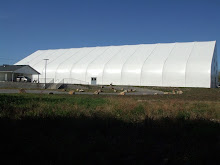
CCSC consists of two buildings. The main building, which we call Building 1, really has to be seen to be believed. It's huge. 28,800 square feet of clearspan space. Because it's a coverall fabric building, it is light and airy inside. The dimensions are 120' wide by 240' long. Big enough for a 2-ring agility trial and room to spare; our regular setup includes one full-sized and one supplementary agility ring and four smaller rings for obedience, Rally, and conformation. Building 1 is heated and air conditioning is coming soon. The flooring is very dog friendly—3/4" recycled rubber on top of 6 feet of crushed lime. Building 2 is our small building. It has restrooms, a dogwash area, two offices and a break room along with a meeting room. One of the offices hosts a weekly visit from Dr. Sherri Russell, DVM and board certified in acupuncture. Both buildings are available for rent for dog and non-dog activities!
What will we be blogging?
We'll be blogging whatever strikes our fancy. It'll be dog related and/or CCSC related. All three owners and one of the instructors will be blogging. Enjoy!